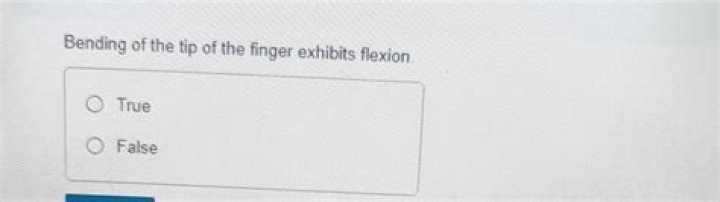
bending of the tip of the finger exhibits flexion.

Emma Johnson
Published Apr 05, 2026
opposition. The saddle joint between metacarpal I of the thumb and the trapezium allows a movement called opposition–the action taken when you touch your thumb to the tips of the other fingers on the same hand. It is opposition that makes the human hand such a fine tool for grasping and manipulating objects.
What is an example of a Synarthrotic joint?
A synarthrosis is a joint that is essentially immobile. This type of joint provides for a strong connection between the adjacent bones, which serves to protect internal structures such as the brain or heart. Examples include the fibrous joints of the skull sutures and the cartilaginous manubriosternal joint.
Is flexion of the ankle so that the superior aspect of the foot approaches the shin is called dorsiflexion?
Flexion of the ankle so that the superior aspect of the foot approaches the shin is called dorsiflexion.
What is it called when a ballerina points her toes?
cruciate ligaments. In the classification of joints, which of the following is TRUE? All synovial joints are freely movable. When a ballerina points the toes, the ankle movement is known as ____. plantar flexion.
How does a finger flex?
The flexor muscles on the palm side of the forearm form into flexor tendons which run into the palm and attach to each finger. When the muscle fires, the attached tendon pulls its finger into a curled, flexed position into the palm.
What motion occurs at the thumb?
Purpose. The movements at each thumb joint are flexion and extension (called radial abduction in the CMCJ) and additional movements of anteposition, retroposition and opposition at the CMCJ, due to the saddle shape of the articulation.
What is an example of syndesmosis?
Syndesmosis. A syndesmosis is a non-movable fibrous joint in which bones such as the tibia and fibula are joined together by connective tissue. An example is the distal tibiofibular joint. Injuries to the ankle syndesmosis are commonly known as a “high ankle sprain”.
What are Amphiarthrotic joints?
An amphiarthrosis is a joint that has limited mobility. An example of this type of joint is the cartilaginous joint that unites the bodies of adjacent vertebrae. Filling the gap between the vertebrae is a thick pad of fibrocartilage called an intervertebral disc ([link]).
What is a Trochoid joint?
pivot joint, also called rotary joint, or trochoid joint, in vertebrate anatomy, a freely moveable joint (diarthrosis) that allows only rotary movement around a single axis. The moving bone rotates within a ring that is formed from a second bone and adjoining ligament.
Which is the stronger movement supination or pronation?
Because of the great strength which biceps contributes, supination is a more powerful action than pronation.
Do cruciate ligaments stabilize ball and socket joints?
Cruciate ligaments are important ligaments that stabilize all ball-and-socket joints. Flexion of the ankle so that the superior aspect of the foot approaches the shin is called dorsiflexion. The gripping of the trochlea by the trochlear notch constitutes the “hinge” for the elbow joint.
What are menisci articular discs quizlet?
menisci (articular discs) pads of fibrocartilage that lie between the articular surfaces of the bones and are attached to the fibrous capsule; usually subdivide the synovial cavity; allow differently shaped bones to fit together, maintain stability.
What is a Bourree in ballet?
Definition of bourrée
1 : a 17th century French dance usually in quick duple time also : a musical composition with the rhythm of this dance.
What is Releve ballet?
Relevé is a French term meaning “raised up.” It is one of the basic ballet moves. The dancer starts in a demi-plié and then rises up into demi-pointe (on the balls of the feet) or en pointe (on the toes), either on one foot or both feet.
What are ballet moves called?
Ballet Moves
Plié (plee ay) – means bent, bending – of the knee or knees. Pirouette (peer o wet) – a rotation or spin – a complete turn of the body on one foot, on point or demi-pointe (half- pointe).
Where are the finger flexors?
Finger Flexors
They run down the forearm and within the carpal tunnel. The four tendons glide in sheaths along the hand and fingers and insert into the fingertip bone.
Why do fingers bend when relaxed?
With all the joints in your fingers and toes, they have to be relatively tighter to prevent injury. And the way they attach to the tissues in your hands makes them act like a strong elastic – and that is what keeps your fingers relatively curled up, even at rest.