What is the difference between restricted stock and RSU?

Ava Hudson
Published Apr 05, 2026
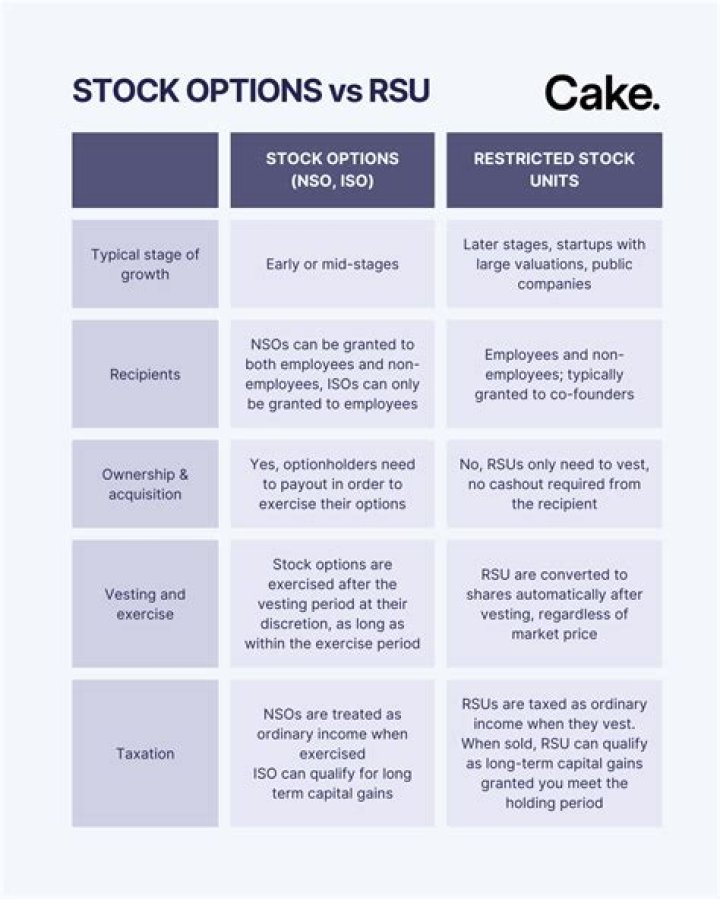
RSU: Stock Options — Gives the holder the right to buy a company’s stock at a future date at a price established at the time of issue. Restricted Stock Units — Gives the holders a commitment to receive the value of a certain number of shares in the future without requiring payment upfront.
Are RSU’s better than stock options?
Restricted stock units
As soon as they vest, they are no longer restricted and are treated exactly the same as if you had bought your company’s shares in the open market. In this way, RSUs carry less risk than stock options. As long as your stock price doesn’t drop to $0, they will always be worth something.
Do RSUs get taxed twice?
Are RSUs taxed twice? No. The value of your shares at vesting is taxed as income, and anything above this amount, if you continue to hold the shares, is taxed at capital gains.
Unlike stock options, which can go “underwater” and lose all practical value with a falling stock price, RSUs are almost always worth something, even if the stock price drops dramatically.
Why are RSUs taxed so high?
Restricted stock units are equivalent to owning a share in your company’s stock. When you receive RSUs as part of your compensation, they are taxed as ordinary income. Instead of receiving the 100 shares of stock, you would receive 78 shares of stock, because 22 shares were sold by your company to cover taxes.
Companies move from issuing employee stock options to restricted stock units (RSU) as they become larger for at least the following reasons: The value of RSUs are easier to understand compared to the upside of options. The cost to exercising options becomes too large of a burden for employees.
Can I sell restricted stock?
Restricted stock units are a form of stock-based employee compensation. RSUs are restricted during a vesting period that may last several years, during which time they cannot be sold. Units are just like any other shares of company stock once they are vested.
Should I sell RSU when they vest?
Given that RSUs are taxed as ordinary income and there is no tax benefit for holding them, I recommend you sell as soon as you vest and use the proceeds to fund your other financial goals.
Holders have no voting rights nor do they receive any dividends paid while they hold the RSUs. Some companies will pay dividend equivalents on the RSUs. Companies can let dividends accrue and use these funds to cover some of the taxes due at vesting.
Is restricted stock considered issued?
A stock option gives you the right to buy a set number of shares at a fixed price, but you don’t own the shares until you buy them. With restricted stock, you own the shares from the day they are issued.
Is RSU part of CTC?
RSU, ESOP, and ESPP are the benefits that an employee receives during his/her first job. Though these benefits are included in the CTC package, people often don’t know much about the benefits and tax implications of these benefits. ESPP, ESOP and RSU are benefits granted to individuals during their first job.
What can you do with restricted stock units?
Generally speaking, when your restricted stock units vest, you gain full rights and ownership to the value of the units. Often, the value is transferred to you in the form of shares of company stock. However, it is possible that your company can settle the value of the units with cash.
An Amazon RSU is the right to receive a share or payout at a future date or subject, to some performance condition. It is gifted by Amazon at the start of your employment. For reference, one RSU equals one share of stock once you become vested. You’ll receive a vesting schedule based on your compensation.
Can you make an 83 B election on RSU?
The taxation of RSUs is a bit simpler than for standard restricted stock plans. Because there is no actual stock issued at grant, no Section 83(b) election is permitted. This means that there is only one date in the life of the plan on which the value of the stock can be declared.
How do I avoid paying taxes on RSU?
The first way to avoid taxes on RSUs is to put additional money into your 401(k). The maximum contribution you can make for 2021 is $19,500 if you’re under age 50. If you’re over age 50, you can contribute an additional $6,000.
Do restricted stock units expire?
RSUs are converted to shares once they are vested, and therefore do not expire. Options have a stated expiration date (often, but not always, 10 years from the date they are granted.) RSUs are taxed as ordinary income at the time they become vested and liquid.
When you receive an RSU, you don’t have any immediate tax liability. You only have to pay taxes when your RSU vests and you receive an actual payout of stock shares. At that point, you have to report income based on the fair market value of the stock.
What is ISO vs NSO?
Summary. NSOs (Non-qualified Stock Options) can be used to compensate employees, consultants, directors, business partners, and advisors. ISOs (Incentive Stock Options) can only be used to compensate employees. NSOs are taxed as regular income at the time of exercise and are not eligible for an IRS section 83b election